 THE UNIVERSITY OF CHICAGO
November 10-11, 2023
Franke Institute for the Humanities
1100 E. 57th Street, Chicago, IL 60637
Registration Required, click here
Event Poster, click here
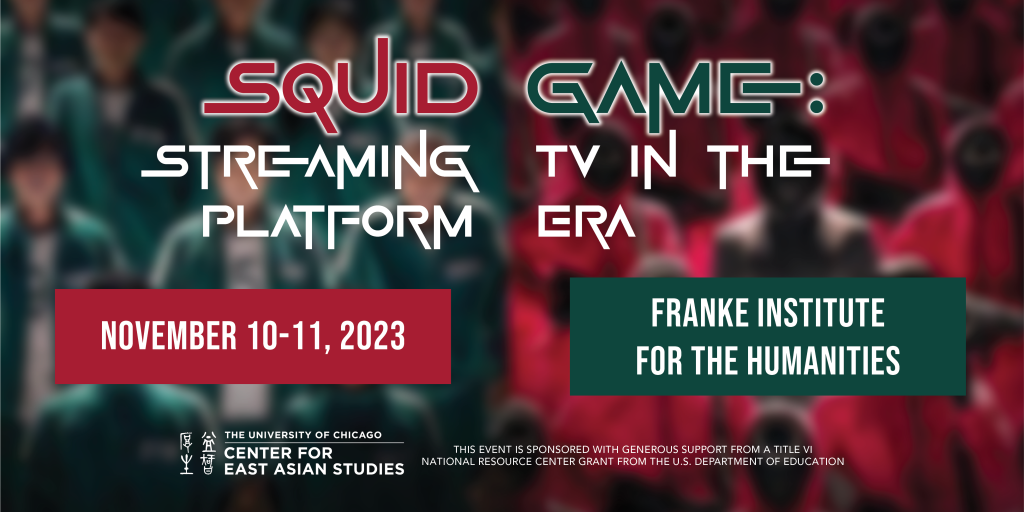
This two day workshop brings together scholars who work on television, social media, and digital platforms to think about how streaming platforms are changing the global circulation of tele-visual content. Using the success of Netflix’s Squid Game as a starting point, the participants will consider how streaming has changed what and how the world watches television; how it is reconfiguring the relation between producers and consumers across local contexts, particularly in East Asia; and how its interaction with other cultural platforms, like social media, encourage us to reconceptualize past ideas about audience response and the social uses of television.
This program is co-organized by Tom Lamarre (University of Chicago), So Yoon Lee (University of Chicago), Hoyt Long (University of Chicago), Richard Jean So (McGill University), and Aarthi Vadde (Duke University).
FRIDAY, NOVEMBER 10
1:00 - 1:10 pm
Welcome Remarks/Introductions
1:10 - 1:55 pm
Opening Keynote: Phillip Maciak - "Dump Aesthetics: Streaming, Serialization, Second Screens"
(Moderator: Aarthi Vadde)
2:00 - 3:30 pm
Session 1 (Moderator: Hoyt Long)
- Stephany Noh - "The Material Conditions of the Production of Squid Game and its Value Proposition"
- Marc Steinberg - "Streaming Convenience: A View From the Japanese Convenience Store"
3:30 - 3:45 pm
Break
3:45 - 5:15 pm
Session 2 (Moderator: So Yoon)
- Dahye Kim - "The Age of Speculative Spectacle: The Post-IMF Cultural Economy and Stock Market Gamblers"
- Doobo Shim - "Racial Representations in the Squid Game and Hallyu"
5:30 - 6:30 pm
Reception
SATURDAY, NOVEMBER 11
10:00 - 11:30 am
Session 3
- Thomas Lamarre & Hoyt Long - "Crisis as Glocal Format: Reading Squid Game Through the ACG Industrial Complex"
- Aarthi Vadde & Richard Jean So - "TV Talk: Social and Aesthetic Dynamics of Viewer Response on Reddit"
11:30 - 1:00 pm
Lunch
1:00 - 2:45 pm
Session 4 (Moderator: Richard Jean So)
- Deen Freelon - "Speech as Data: Toward a Methodological Framework for Studying Political Talk"
- Eunji Kim - "Unseen Politics: Hidden Impact of Entertainment Media in Unequal America"
2:45 - 3:00 pm
Break
3:00 - 4:15 pm
Keynote Lecture: Amanda Lotz - "Screen Stories and Media Microcultures: Navigating Industrial and Critical Challenges"
(Moderator: Thomas Lamarre)
4:15 - 5:00 pm
Closing Discussion and/or Roundtable
Thomas Lamarre is a scholar of media, cinema and animation, intellectual history and material culture, with projects ranging from the communication networks of 9th century Japan (Uncovering Heian Japan: An Archaeology of Sensation and Inscription, 2000), to silent cinema and the global imaginary (Shadows on the Screen: Tanizaki Jun’ichirō on Cinema and Oriental Aesthetics, 2005), animation technologies (The Anime Machine: A Media Theory of Animation, 2009) and on television infrastructures and media ecology (The Anime Ecology: A Genealogy of Television, Animation, and Game Media, 2018). Current projects include research on animation that addresses the use of animals in the formation of media networks associated with colonialism and extraterritorial empire, and the consequent politics of animism and speciesism.
Hoyt Long is Professor of Japanese Literature and Digital Studies in the Department of East Asian Languages and Civilizations. His research and teaching interests include the history of media and communication in modern Japan, cultural analytics, platform studies, the sociology of literature, and book history. His latest book is The Values in Numbers: Reading Japanese Literature in a Global Information Age (2021). More recent projects have addressed topics such as online writing platforms, the streaming industry, and machine translation.
Richard Jean So is an associate professor of English and Cultural Analytics at McGill University. He works at the intersection of cultural analysis and data science. Substantively, he uses data-driven methods to study culture, both historical and contemporary, from the novel to Netflix to social media and writing platforms like Reddit and AO3. He has a particular topical interest in race, power, and inequality. Methodologically, he attempts to bring together humanist methods of interpretation, such as close reading, with new computational methods, such as machine learning and natural language processing. He also has a keen interest in reconciling critical race theory with digital methods.
Aarthi Vadde is Associate Professor of English at Duke University. Her research areas include contemporary literature and computational culture with a background in modernist and postcolonial studies. She is the author of Chimeras of Form: Modernist Internationalism beyond Europe (Columbia UP, 2016), which won the ACLA’s 2018 Harry Levin Prize. Her current book project is titled “We the Platform: Contemporary Literature after Web 2.0.” Aarthi is the co-editor of several books: The Norton Anthology of English Literature, 11th edition (2024), The Palgrave Handbook of 20th and 21st Century Literature and Science (2020), and The Critic as Amateur (Bloomsbury 2019). She co-edited an open-access cluster of essays entitled Web 2.0 and Literary Criticism (Post45) and co-founded Novel Dialogue, a podcast about how novels are made—and what to make of them. Her scholarly articles have appeared in Comparative Literature, Modern Fiction Studies, Modernism/Modernity, New Literary History, NOVEL, and PMLA amongst other venues.
So Yoon Lee's research focuses on the sociocultural and political implications of the developmental state in Asia. Broadly, she is interested in how social change shapes the everyday lived experiences and grievances of different groups and materialize into different phenomena of the present. Her specific empirical interests cover a wide spectrum, ranging from the rise of populist leaders in Asia to the rise of South Korean popular culture.
Amanda D. Lotz is a professor and leader of the Transforming Media Industries research program in the Digital Media Research Centre at Queensland University of Technology. She is the author, curator, or editor of twelve books that explore television and media industries and has consulted and provided strategy guidance about digital change in screen technologies for business and government for more than a decade. She has published articles about the business of television at Quartz, Salon, and The New Republic, hosted the Media Business Matters podcast (2014-18), and writes about television and media on LinkedIn. She was named a Fellow of the International Communication Association in 2020.
Phillip Maciak is the television critic for The New Republic and Senior Lecturer in English and American Culture Studies at Washington University in St. Louis. He is the author of the books Avidly Reads Screen Time (NYU 2023) and The Disappearing Christ: Secularism in the Silent Era (Columbia 2019). He was television editor at The Los Angeles Review of Books for seven years and remains editor-at-large, and he is the co-editor of the 2015 PMLA special section, "The Semi-Public Intellectual." His essays and reviews have appeared in The New York Times Magazine, Slate, Wired, J19, and Film Quarterly.
Hyun Jung Stephany Noh is a Ph.D. candidate at the Department of Radio-Television-Film at Moody College of Communication, the University of Texas at Austin. Her interdisciplinary research spans global media, media industries, and public diplomacy with a special focus on the Korean Wave or hallyu. Her interest in media studies originates from 10 years of work experience in Korean television networks as a programming producer, ratings analyst, acquisition specialist, and production budget manager. She is currently writing her dissertation “Streaming K-drama” that investigates the cultural implications of the transnational phenomenon by researching the context of television programs and the shifts of industry practices formed in the streaming environment.
Dahye Kim is an Assistant Professor of Asian Languages and Cultures at Northwestern University. Her research and teaching focus on modern Korean literature and culture, critical approaches to media history, and the cultural dimensions of communication technologies in East Asia. Dahye is particularly interested in exploring the evolving significance and signification of literature and literacy in the digital age. Her current project, tentatively titled “Techno-fiction: Science Fictional Dreams of Linguistic Metamorphosis and the informatization of Korean Writing,” delves into the radical transformation of writing and literature in the new technological environment of the 1980s and 1990s South Korea. She has published on a wide range of topics, from colonial era Korean literature to webtoons.
Doobo Shim is a professor in the Department of Media and Communication at Sungshin University, South Korea. He previously served as an assistant professor at the National University of Singapore and a visiting scholar at Duke University, USA. He researches media and communication within critical, cultural and historical perspectives, while his recent work focused on the rise of Korean popular culture in Asia. His work was honored by the National Communication Association (USA) and at the Global Fusion Conference. He holds a PhD from the University of Wisconsin-Madison.
Marc Steinberg is Professor of Film and Moving Image Studies at Concordia University, Montreal, and director of The Platform Lab. He is the author of Anime’s Media Mix: Franchising Toys and Characters in Japan (University of Minnesota Press, 2012), The Platform Economy: How Japan Transformed the Commercial Internet (University of Minnesota Press, 2019), and co-author of Media and Management (University of Minnesota Press, 2021). He is the co-editor of Media Theory in Japan (Duke University Press, 2017), as well as special issues of Asiascape: Digital Asia on “Regional Platforms,” Media, Culture & Society on “Media Power in Digital Asia: Super Apps and Megacorps.” He is currently at work on a project on on-demand platforms, convenience stores, and convenience culture.
Deen Freelon is the Allan Randall Freelon Sr. Professor at the Annenberg School for Communication. A widely recognized expert on digital politics and computational social science, he has authored or coauthored over 60 book chapters, funded reports, and articles in journals such as Nature, Science, and the Proceedings of the National Academy of Sciences. He was one of the first communication researchers to apply computational methods to social media data and has developed eight open-source research software packages. His research and commentary have been featured in press outlets including the Washington Post, NPR, The Atlantic, Buzzfeed, Vox, USA Today, the BBC, PBS NewsHour, CBS News, NBC News, and many others. Unlike many computational social scientists, he centers questions of identity and power in his work, paying particular attention to race, gender, and ideology.
Eunji Kim is an Assistant Professor in the Department of Political Science. She specializes in political communication and public opinion in American politics. Prior to joining Columbia University, she was an Assistant Professor of Political Science at Vanderbilt University. She received a joint Ph.D. in political science (Arts & Sciences) and communication (Annenberg) and an M.A. in statistics (Wharton) from the University of Pennsylvania. She received a B.A. in government from Harvard University. Professor Kim’s research has been funded by Facebook as well as the Russell Sage Foundation. Her research has received several prizes, including the American Political Science Association’s Best Dissertation in Political Psychology Award, Best Article in Political Behavior Award, Paul Lazarsfeld Best Paper Award, Wilson Carey McWilliams Best Paper Award; International Communication Association’s Kaid-Sanders Best Political Communication Article Award; the International Society of Political Psychology’s Roberta Sigel Early Career Scholar Paper Award. Her work has been published in the American Journal of Political Science, Proceedings of the National Academy of Sciences, Public Opinion Quarterly, Political Behavior, Political Psychology, International Organization, Research & Politics, and Quarterly Journal of Political Science.
This event is sponsored with generous support from a Title VI National Resource Center Grant from the U.S. Department of Education.